Living Two Lives

“Trauma, by definition, is unbearable and intolerable. Most rape victims,
combat soldiers, and children who have been molested become so upset when
they think about what they experienced that they try to push it out of their minds,
trying to act as if nothing happened, and move on. It takes tremendous energy to
keep functioning while carrying the memory of terror, and the shame of utter
weakness and vulnerability.”
The Body Keeps the Score by Bessel Van Der Kolk

The silent vigil guarding traumatic events from seeping out into the present became a tragic re-abuse of myself on a major scale. Imagine having a “shameful” nightmare straight out of the depths of your own private hell. Imagine waking up to a body filled with shame and horror, fear of being found out, believing you are a bad person, even the villain and not the victim at all.

Now imagine having to tuck all that ugliness deep inside of you to face your young children, to care for them, feed them, be loving and nurturing. It’s like living two lives in one body. I did my best, I know I did, but it was not enough. In an ideal world there would have been help and support for traumatized children like me, a safe place to begin to shed the life scarring aftereffects of trauma imprinted in my body. Then my children might have enjoyed the kind of mother that all children deserve just by being born.

Instead I lived in fear of being “found out.” I believed I would be shunned and cast aside by my husband, the world in general, and most certainly the family I grew up in that had already secured my silence.

I was alone. I manned the gates of my private hell alone. But all along the perimeter were tell-tale signs of escape attempts like the silent scream that ran through my body begging to be let loose. It showed in bouts of panic, depression, and sudden rages seemingly out of nowhere. And well into my thirties I still felt the DeGolier “label” imprinted on my forehead for all to see and know my shame.

Then one day the depths of hell escaped into the light, and I began a long healing journey. But the difficulty of the journey equaled the depth of the trauma and thirty years on I am still working to be free though I know now the best I can ever be is enlightened. At least it is not still wreaking havoc on my insides.

Victims of trauma. What to do with them. Ignore? Shun? Medicate? Talk them to death? Tell them to get over it? Tell them what you would do in the same situation or what they should have done different? Perhaps read scripture and pray?

It seems to be that yoga and mindfulness are effective with many such victims. I have not tried yoga yet, it’s on my list, but practicing mindfulness and meditation are already part of my daily life, a calmer life.

No person can number the suffering humanity both from trauma and the echoing silence afterwards. The best outcome I can hope for is to try to help the next person. Yes, without a PHD and without being a finished product myself. People to people support is amazing. That is how I began to free myself, listening to other women’s stories in AA rooms. I have not been alone since.
Imprint of Trauma

However, trauma is much more than a story about something that happened long

ago. The emotions and physical sensations that were imprinted during the trauma

are experienced not as memories but as disruptive physical reactions in the

present.

In order to regain control over your self, you need to revisit the trauma:

Sooner or later you need to confront what has happened to you, but only after

you feel safe and will not be retraumatized by it. The first order of business is to

find ways to cope with feeling overwhelmed by the sensations and emotions

associated with the past.

As the previous parts of this book have shown, the engines of posttraumatic

reactions are located in the emotional brain. In contrast with the rational brain,

which expresses itself in thoughts, the emotional brain manifests itself in

physical reactions: gut-wrenching sensations, heart pounding, breathing

becoming fast and shallow, feelings of heartbreak, speaking with an uptight and

reedy voice, and the characteristic body movements that signify collapse,

rigidity, rage, or defensiveness.

Why can’t we just be reasonable? And can understanding help? The rational,

executive brain is good at helping us understand where feelings come from (as

in: “I get scared when I get close to a guy because my father molested me” or “I

have trouble expressing my love toward my son because I feel guilty about

having killed a child in Iraq”). However, the rational brain cannot abolish

emotions, sensations, or thoughts (such as living with a low-level sense of threat

or feeling that you are fundamentally a terrible person, even though you

rationally know that you are not to blame for having been raped). Understanding

why you feel a certain way does not change how you feel. But it can keep you

from surrendering to intense reactions (for example, assaulting a boss who

reminds you of a perpetrator, breaking up with a lover at your first disagreement,

or jumping into the arms of a stranger). However, the more frazzled we are, the

more our rational brains take a backseat to our emotions.3

LIMBIC SYSTEM THERAPY

The fundamental issue in resolving traumatic stress is to restore the proper

balance between the rational and emotional brains, so that you can feel in charge

of how you respond and how you conduct your life. When we’re triggered into

states of hyper-or hypoarousal, we are pushed outside our “window of

tolerance”—the range of optimal functioning.4 We become reactive and

disorganized; our filters stop working—sounds and lights bother us, unwanted

images from the past intrude on our minds, and we panic or fly into rages. If

we’re shut down, we feel numb in body and mind; our thinking becomes

sluggish and we have trouble getting out of our chairs.

As long as people are either hyperaroused or shut down, they cannot learn

from experience.” The Body Keeps the Score by Bessel Van Der Kolk

This describes my life, emotional, erratic, thoughtless, driven by intense emotions linked directly to the many traumas of the past that bid me silence.

I cannot number the times my mind has gone back to actions and reactions that were completely out of my control, yet I own them; the time I called for help because I didn’t want to go back to Florida with Bob, but knew it was inevitable left to my own devices; the time before that when my ex said a ghastly thing to me about my worth as a person triggering the flight response. Florida became a relatively “safe haven.”

Hospitalization became another safe place when I could neither fathom or control my chaotic emotions.

I am glad for the insight, and sad at the years it took from my family and myself. Also sad that at 66, I must work so hard to heal my ravaged insides. But I am not alone in this.

Not all trauma leaves people with PTSD. Suffering in silence, as was typical for abuse victims in my generation and before, and as many people still think abuse should be silenced and buried, contributes to years of re-abuse by others and our own bodies. Our bodies work against us by keeping the score, they tell us things are happening that are no longer happening. We react, fight or flight, and then the roller-coaster continues with a mind of its own.

I am told I can learn to disarm the power my triggers have over my actions with mindfulness. It seems to be working. I am grateful.

Trauma’s Imprint

CHAPTER 13

HEALING FROM TRAUMA: OWNING

YOUR SELF

Nobody can “treat” a war, or abuse, rape, molestation, or any other

horrendous event, for that matter; what has happened cannot be undone.

But what can be dealt with are the imprints of the trauma on body, mind, and

soul: the crushing sensations in your chest that you may label as anxiety or

depression; the fear of losing control; always being on alert for danger or

rejection; the self-loathing; the nightmares and flashbacks; the fog that keeps

you from staying on task and from engaging fully in what you are doing; being

unable to fully open your heart to another human being.

Trauma robs you of the feeling that you are in charge of yourself, of what I

will call self-leadership in the chapters to come.1 The challenge of recovery is to

reestablish ownership of your body and your mind—of your self. This means

feeling free to know what you know and to feel what you feel without becoming

overwhelmed, enraged, ashamed, or collapsed. For most people this involves (1)

finding a way to become calm and focused, (2) learning to maintain that calm in

response to images, thoughts, sounds, or physical sensations that remind you of

the past, (3) finding a way to be fully alive in the present and engaged with the

people around you, (4) not having to keep secrets from yourself, including

secrets about the ways that you have managed to survive.” by Bessel Van Der Kolk

Some empty advice for a trauma survivor:

Just let it go. (Really, you think I am holding on with a death grip to my trauma?)

Put it behind you and move on. (It is a part of me)

Just be happy now. (How, tell me how when the trauma still works independent of my conscious mind.)

Just get over it. (Sounds so simple, and makes trauma survivors feel stupid and weak. They are neither.)

People mean well, but they may as well tell me to go learn all about quantum physics in five minutes. I know, five minutes of talking to my grandsons about quantum physics taught me.

Learning that my trauma’s made an imprint on my body and mind has taken a measure of my burden from my shoulders. I am still responsible for actions and reactions that harmed others, but hearing that many things were out of my conscious control, immune to choices I would prefer to have made and not due to my “inherent evil” gene has been a relief to my heart.

This is where the healing begins picking up speed I think, right after owning all my baggage and learning what the real trouble is. I am learning tools to help disarm the trauma triggers. The triggers will continue to evoke emotions. With a new ability to be mindfully aware of those emotions I am learning also to react to current situations instead of the full blown spectrum of childhood trauma. I can safely say I do not think another hospital visit will occur and that alone brings me a measure of peace.

There will always be some people who refuse to believe I was raised in anything but an idyllic home. They would read this and scoff. But those I speak of have an agenda to continually discredit me. I know truths they do not want me to speak of. I must be labeled “crazy.” And those people have toiled long to make sure I am not believed.

It does not matter anymore who believes. I am working on me and will continue.

Blaming

Research on the effects of early maltreatment tells a different story: that

early maltreatment has enduring negative effects on brain development.

Our brains are sculpted by our early experiences. Maltreatment is a

chisel that shapes a brain to contend with strife, but at the cost of deep,

enduring wounds. Childhood abuse isn’t something you “get over.” It is

an evil that we must acknowledge and confront if we aim to do

anything about the unchecked cycle of violence in this country.”

—Martin Teicher, MD, PhD, Scientific American

There are hundreds of thousands of children like the ones I am about to

describe, and they absorb enormous resources, often without appreciable

benefit. They end up filling our jails, our welfare rolls, and our medical clinics.

Most of the public knows them only as statistics. Tens of thousands of schoolteachers, probation officers, welfare workers, judges, and mental health

professionals spend their days trying to help them, and the taxpayer pays the

bills.” The Body Keeps the Score by Bessel Van Der Kolk

I once sat with a boyfriend, Blue, in the office of a Child Behavioral Psychologist being hushed when I tried to say that Blue’s son’s troubles could not be resolved without full disclosure of the facts. Even then I knew, from being an ineffective mother, (notice how I avoid the word abuse) and having an ineffective mother, that what we adults do affects our children long term.

Gee, what a mouthful. Blue was not a person capable of owning his mistakes. This was his son’s problem and had nothing to do with him. Yes, he was a narcissist and pathological liar, thus abusive by the very nature of his interactions with his son. But it was not only Blue’s interactions, mine were abusive by the very nature of the relationship with Blue, my resentment of unwillingly being manipulated into acting as a “mother” to his child, and my complete inability to be who they both wanted me to be. Also, being in a relationship with a narcissist is tough on all members of a “family” group. I was a mess. Blue was a mess. And without any of that coming into the conversation, the child would remain a mess.

I get that most people want to believe that once a person reaches a certain age there is no blaming of parents or other people for their behaviors, but it simply is not true. Yes, there is a point where children become masters of their own ship so to speak, but the ship is often by then carrying a cargo of internal crap that cannot be simply offloaded to a dock somewhere and “left behind.”

Our bodies do indeed keep the score. As adults many struggle with disorders, alcohol, drugs, jail, suicide, and the cause is never fully addressed. Society looks on these people as bad, weak, lazy, selfish, but what many are is people just trying to survive.

I blamed my ills on the family I grew up in and later I added many people to that list. Blaming can waste a lot of life, but there is a difference between blame for blame’s sake and holding people accountable for what they did or failed to do. There is also a difference between blame and simply returning to past traumas in order to deal with it.

I detest memes that say “you and you alone are responsible for every choice you made.” as though we are suddenly born to adulthood and now the 18 years of bad or warped messaging just disappears from our minds.

Did I make a bad choice to marry to get away from home at 17? Let me see, I was afraid of two of my brothers who were active predators and my father who assaulted me and a mother who knew and would not for a moment protect me. I saw a way out and went for it. I chose, yes. I did not see another way. And remember my sex life began at 3 ½ years. My mind was beyond warped by the family I grew up in.

Of course, my maltreatment was extreme. Maltreatment, abuse, neglect, abandonment, witnessing domestic abuse or a family torn apart by alcohol, the list of traumas is endless when it comes to affects on a child’s developing brain. And to be told at adulthood the choice is now yours, what the heck do people think is going to come out of that messed up mind? Messed up choices.

And you can say all day long that so-and-so was beaten as a child and look what he/she managed to accomplish but it is a mute point because every child is different, even within a family group. Comparison’s are irrelevant and ineffective.

I continue to learn. We ought all continue to learn.

Crazy?

These reactions are irrational and largely outside people’s control. Intense

and barely controllable urges and emotions make people feel crazy—and makes

them feel they don’t belong to the human race. Feeling numb during birthday

parties for your kids or in response to the death of loved ones makes people feel

like monsters. As a result, shame becomes the dominant emotion and hiding the

truth the central preoccupation.

They are rarely in touch with the origins of their alienation. That is where

therapy comes in—is the beginning of bringing the emotions that were generated

by trauma being able to feel, the capacity to observe oneself online. However,

the bottom line is that the threat-perception system of the brain has changed, and

people’s physical reactions are dictated by the imprint of the past.

The trauma that started “out there” is now played out on the battlefield of

their own bodies, usually without a conscious connection between what

happened back then and what is going on right now inside. The challenge is not

so much learning to accept the terrible things that have happened but learning

how to gain mastery over one’s internal sensations and emotions. Sensing,

naming, and identifying what is going on inside is the first step to recovery.” The Body Keeps the Score Bessel Van Der Kolk

I have felt “crazy” for most of my life, unable to puzzle out why my reactions were so “over the top” to even ordinary events. I remember as far back as 8th grade asking the school psychologist if she could tell if I were crazy. I suppose I “earned” the label of “crazy” that my first husband gave me though it was not accurate.

The childhood traumas I vowed to never speak of were screaming out in outrageous ways. My trauma owned me, dictated my actions, reactions, choices, decisions and my life spun ever quicker out of control.

This is not about blaming others, irregardless of their responsibility for the harm done to me; it is me owning my actions and reactions and beginning to take back my power to live mindful of those actions and reactions erupting from the childhood imprint on my mind and body.

Sometimes I feel I am too old for it all to matter. My immediate response is no, it matters because there are millions of others, young and old, who need to know the truth. The truth about me? I am merely an example to learn from, but if I reach one life with my story, I am satisfied, because the ripple effect and the sheer volume of others stories of trauma, survival, and recovery will one day cover the earth.

In truth, I have touched more than one life through my book, my radio blog, and my posts to YouTube but there is more to learn and more to share and more people every day that need some sliver of hope.

Grandiose? That is my sister Joyce’s word for me. According to her I need a PHD. But no one can shine a light in dark corners as well as a person who has been there and lived to tell about it.

There will always be people who want the dark side of life hidden away, skeletons kept in closets. Just walk away, be happy, it’s over, get on with your life, and all the while traumatized people try to comply the skeletons rattle inside them making them seem and feel “crazy.”

Memory

Memory is a topic I am very interested in as it and many who question it have been a challenge to me.

It has not been enough to know I remember. Like so many others I questioned why I remember certain things like it were yesterday and yet there are years of my childhood I cannot recall. I questioned the memories themselves as many survivors do when memory presents unbelievable events.

“Did it really happen?” “Did it happen the way I remember?” Part of me knows full well it did and the rest of me wants it not to be true. And so the battle has raged internally for most of my life.

Others question my memory also. “How could you possibly remember back that far?” or “You weren’t even born when that happened.” or “Where did you dream that one up?”

This book has given me a lot of clarity about my life, my memory, and how the mind and body both remember the trauma of childhood.

I am very grateful.

The extraordinary capacity of the human mind to rewrite memory is

illustrated in the Grant Study of Adult Development, which has systematically

followed the psychological and physical health of more than two hundred

Harvard men from their sophomore years of 1939–44 to the present.2 Of course,

the designers of the study could not have anticipated that most of the participants

would go off to fight in World War II, but we can now track the evolution of

their wartime memories. The men were interviewed in detail about their war

experiences in 1945/1946 and again in 1989/1990. Four and a half decades later,

the majority gave very different accounts from the narratives recorded in their

immediate postwar interviews: With the passage of time, events had been

bleached of their intense horror.

In contrast, those who had been traumatized and

subsequently developed PTSD did not modify their accounts; their memories

were preserved essentially intact forty-five years after the war ended.

Whether we remember a particular event at all, and how accurate our

memories of it are, largely depends on how personally meaningful it was and

how emotional we felt about it at the time. The key factor is our level of arousal.

We all have memories associated with particular people, songs, smells, and

places that stay with us for a long time. Most of us still have precise memories of

where we were and what we saw on Tuesday, September 11, 2001, but only a

fraction of us recall anything in particular about September 10.” Bessel Van Der Kolk

Swept Under the Rug

World War I

As the war wore on, shell shock increasingly compromised the efficiency of
the fighting forces. Caught between taking the suffering of their soldiers
seriously and pursuing victory over the Germans, the British General Staff
issued General Routine Order Number 2384 in June of 1917, which stated, “In
no circumstances whatever will the expression ‘shell shock’ be used verbally or
be recorded in any regimental or other casualty report, or any hospital or other
medical document.” All soldiers with psychiatric problems were to be given a
single diagnosis of “NYDN” (Not Yet Diagnosed, Nervous).4 In November 1917
the General Staff denied Charles Samuel Myers, who ran four field hospitals for
wounded soldiers, permission to submit a paper on shell shock to the British
Medical Journal. The Germans were even more punitive and treated shell shock
as a character defect, which they managed with a variety of painful treatments,
including electroshock.
In 1922 the British government issued the Southborough Report, whose goal
was to prevent the diagnosis of shell shock in any future wars and to undermine
any more claims for compensation. It suggested the elimination of shell shock
from all official nomenclature and insisted that these cases should no more be
classified “as a battle casualty than sickness or disease is so regarded.”5 The
official view was that well-trained troops, properly led, would not suffer from
shell shock and that the servicemen who had succumbed to the disorder were
undisciplined and unwilling soldiers. While the political storm about the
legitimacy of shell shock continued to rage for several more years, reports on
how to best treat these cases disappeared from the scientific literature.
The Body Keeps the Score by Bessel Van Der Kolk

That is just part of the history of trauma research. And the battle continues.

Someone always has an agenda, power, control, money as in all the drugs sold to control difficult children, and adults. No conspiracy theory here, just hard cold fact. At least I see it as cold, certainly inhumane.

The effects of trauma are still swept under the rug but as I know little about the military and tons about surviving childhood abuse, including incest. I will stick to my own experience.

Nobody wants to know there is child abuse. Nobody wants to know there is rampant incest. But all the people who say “this has nothing to do with me” “this could never happen in my family” or “my child would never LET anyone…” are wrong. They remain willfully ignorant and part of the challenge.

Reading this book has opened my own eyes; I knew what happened to me, and I watched my life unfold with a will of its own, mind boggled at my lack of control over it. Now I see the bigger picture. I am sad and angry that my life was hi-jacked by the trauma imprint on my brain and all the people who swept trauma as the cause under the rug.

Freud was one of the earliest people to talk about the trauma of incest but he backed off when he realized it would implicate his father. We are not new to families protecting their own.

Something has to change. People need to say “how can I help” instead of “just get over it” because there is no such thing as just getting over trauma, the body does keep the score and my reactions to triggers has exploded my world time and time again as well as my children’s worlds.

I wish every person who has been through trauma or knows someone who has would read this book.

Minding the Children

CHILD ABUSE: OUR NATION’S LARGEST PUBLIC HEALTH

PROBLEM

The first time I heard Robert Anda present the results of the ACE study, he could

not hold back his tears. In his career at the CDC he had previously worked in

several major risk areas, including tobacco research and cardiovascular health.

But when the ACE study data started to appear on his computer screen, he

realized that they had stumbled upon the gravest and most costly public health

issue in the United States: child abuse. He had calculated that its overall costs

exceeded those of cancer or heart disease and that eradicating child abuse in

America would reduce the overall rate of depression by more than half,

alcoholism by two-thirds, and suicide, IV drug use, and domestic violence by

20

three-quarters.

It would also have a dramatic effect on workplace performance

and vastly decrease the need for incarceration.

When the surgeon general’s report on smoking and health was published in

1964, it unleashed a decades-long legal and medical campaign that has changed

daily life and long-term health prospects for millions. The number of American smokers fell from 42 percent of adults in 1965 to 19 percent in 2010, and it is

estimated that nearly 800,000 deaths from lung cancer were prevented between

2000.21

1975 and

The ACE study, however, has had no such effect. Follow-up studies and

papers are still appearing around the world, but the day-to-day reality of children

like Marilyn and the children in outpatient clinics and residential treatment

centers around the country remains virtually the same. Only now they receive

high doses of psychotropic agents, which makes them more tractable but which

also impairs their ability to feel pleasure and curiosity, to grow and develop

emotionally and intellectually, and to become contributing members of society.” The Body Keeps the Score by Bessel Van Der Kolk

The idea has been in the back of my mind, the front of my mind, and out of my mouth for many years, due to my own experience, that somehow we have to stop passing on our nightmares to the next generation. The thing is, how? I couldn’t reach beyond survival for so very long. How could I have any fruitful impact on anyone?

To read these words brought tears to my eyes also, for my children and their children and all the generations that do not address this epidemic.

In my day, it was nobodies business what you did to your children or spouse, as long as you didn’t kill them. At my book signing at the Brocton, NY Museum a few people told my sisters and I that it was known that terrible things happened on our farm, but what could they do? I like to think that attitude is changing, but until children are no longer considered property to be raised as any random parent sees fit, or unfit, the futures of vast numbers of children will be bleak at best.

I have been put down, rejected, called looney for speaking out about my own life. But things do not change until people are made aware of the need, and no one sees the need until enough people speak it.

Even then, there seems to be a blind spot when it comes to abuse, rape, incest, or domestic violence.

It is a silent epidemic perhaps because the children often have no safe person to tell, and the adults who know keep silent out of shame.

I cannot keep silent. What most people have no clue about, is the enormous, long lasting effect on children’s lives as their bodies grow to adulthood while their minds and emotional stability never catch up.

It has been said that I made up my story to excuse my failed, badly lived life. It is a common theme among nay-sayers. It has been said that as a bi-polar person I made up the stories of incest, as bi-polars are prone to do.(Bi-Polar people are not actually prone to claim incest) But I do not fit the DSM criteria for Bi-Polar. A story was concocted that I made up one claim so I would not be stuck on the farm with my aging parents. Another made up the story about me being molested by the minister, but he never touched me.

People have all sorts of ideas of who I am, but notice none have spoken to me directly. Please, spare me any truth or sense of reality!

Abused children are silenced, lied about, and left behind. It is true. It is deadly.

A Foundation

There could be only one explanation for such results: In response to the

trauma itself, and in coping with the dread that persisted long afterward, these

patients had learned to shut down the brain areas that transmit the visceral

feelings and emotions that accompany and define terror. Yet in everyday life,

those same brain areas are responsible for registering the entire range of

emotions and sensations that form the foundation of our self-awareness, our

sense of who we are. What we witnessed here was a tragic adaptation: In an

effort to shut off terrifying sensations, they also deadened their capacity to feel

fully alive.

The disappearance of medial prefrontal activation could explain why so

many traumatized people lose their sense of purpose and direction. I used to be

surprised by how often my patients asked me for advice about the most ordinary

things, and then by how rarely they followed it. Now I understood that their

relationship with their own inner reality was impaired. How could they make

decisions, or put any plan into action, if they couldn’t define what they wanted

or, to be more precise, what the sensations in their bodies, the basis of all

emotions, were trying to tell them?

The lack of self-awareness in victims of chronic childhood trauma is

sometimes so profound that they cannot recognize themselves in a mirror. Brain

scans show that this is not the result of mere inattention: The structures in charge

of self-recognition may be knocked out along with the structures related to self

experience.

When Ruth Lanius showed me her study, a phrase from my classical high

school education came back to me. The mathematician Archimedes, teaching

about the lever, is supposed to have said: “Give me a place to stand and I will

move the world.” Or, as the great twentieth-century body therapist Moshe

Feldenkrais put it: “You can’t do what you want till you know what you’re

doing.” The implications are clear: to feel present you have to know where you

are and be aware of what is going on with you. If the self-sensing system breaks

down we need to find ways to reactivate it.” The Body Keeps the Score by Bessel Van Der Kolk

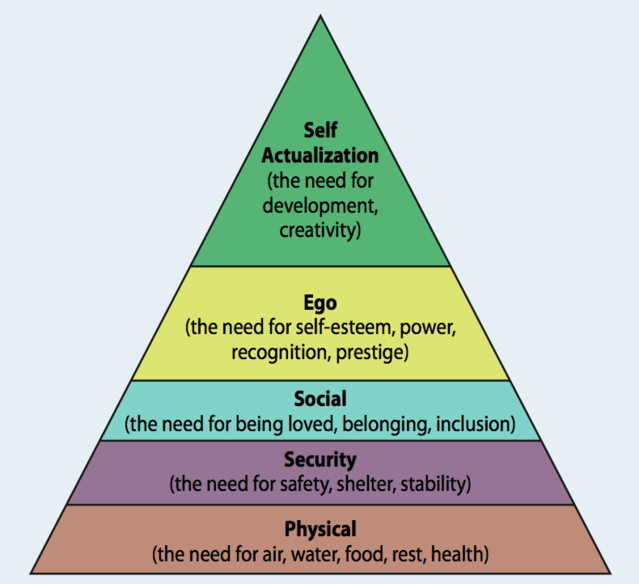
The highlighted portion reminds me a bit of Maslow’s Hierarchy of Needs

Maslow called the bottom four levels of the pyramid ‘deficiency needs’ because a person does not feel anything if they are met, but becomes anxious if they are not. Thus, physiological needs such as eating, drinking, and sleeping are deficiency needs, as are safety needs, social needs such as friendship and sexual intimacy, and ego needs such as self-esteem and recognition. In contrast, Maslow called the fifth level of the pyramid a ‘growth need’ because it enables a person to ‘self-actualize’ or reach his fullest potential as a human being. Once a person has met his deficiency needs, he can turn his attention to self-actualization; however, only a small minority of people are able to self-actualize because self-actualization requires uncommon qualities such as honesty, independence, awareness, objectivity, creativity, and originality.” Taken from Psychology Today https://www.psychologytoday.com/us/blog/hide-and-seek/201205/our-hierarchy-needs

Rarely have I felt assured of basic needs being met although as a child I believed there would be food on the table. But the rage and anguish weighing down the very air I breathed informed me life was tenuous at best.

One memory that stands out was my husband Pete. There was a brief time before he died that I felt secure, loved, a foundation beneath my feet, and a sense of being “home.” That all disappeared when he died 12 days after we married.

Pete was not a husband in the traditional sense of the word. I meant to never marry or even be open to a relationship. I told him so. He was my best friend. I could not lose that.

But on the day after we got the dire news, he asked me to marry him. He told me he had already left everything he owned to me, and marriage to me would make him happy.

There is a funny story attached to that, but not for today.

Peter Norman Noetling loved me in ways no man had ever. He respected me, was concerned for my well-being, he let me be me and never told me what I “should” feel. When he sensed a rough day he would invite me out for “ice-cream therapy” and he was fine if I talked about it or didn’t. He never made me feel guilty or ashamed for being me. There was no more intimacy than the after college class chats when he switched off the TV at my arrival home and we recounted our day.

My sense of safety left when Pete died. He left me money and a house… but that was not security. Pete was my foundation. Though I fought it desperately, Pete was my “home” and he was gone. I felt torn loose like a balloon in a raging storm.

I am so grateful to have known Pete. I am also grateful that when my anger at him leaving subsided, Pete was still there, nurturing and steady.

It has been said that I never deserved what Pete left me. That hurt me when I heard it. The most important item he gave to me was in the breaking down of my heavy suit of armor I had grown over a lifetime of abuse. He gave me space to feel again. It was not that I wanted to feel, he gave me no choice.

I loved Pete for who he was not what he could do for me or I for him. He was the man who had my back when no other man in my life has thought my back worthy of protecting.

Pete may well be the reason I still strive to recover from the abuse and mud-slinging frenzy of family. Pete gave me a taste of the goodness in life.

Fight or Flight

Ordinarily the executive capacities of the prefrontal cortex enable people to
observe what is going on, predict what will happen if they take a certain action,
and make a conscious choice. Being able to hover calmly and objectively over
our thoughts, feelings, and emotions (an ability I’ll call mindfulness throughout
this book) and then take our time to respond allows the executive brain to
inhibit, organize, and modulate the hardwired automatic reactions
preprogrammed into the emotional brain. This capacity is crucial for preserving
our relationships with our fellow human beings. As long as our frontal lobes are
working properly, we’re unlikely to lose our temper every time a waiter is late
with our order or an insurance company agent puts us on hold. (Our watchtower
also tells us that other people’s anger and threats are a function of their
emotional state.) When that system breaks down, we become like conditioned animals: The moment we detect danger we automatically go into fight-or-flight
mode.


In PTSD the critical balance between the amygdala (smoke detector) and the
MPFC (watchtower) shifts radically, which makes it much harder to control
emotions and impulses. Neuroimaging studies of human beings in highly
emotional states reveal that intense fear, sadness, and anger all increase the
activation of subcortical brain regions involved in emotions and significantly
reduce the activity in various areas in the frontal lobe, particularly the MPFC.
When that occurs, the inhibitory capacities of the frontal lobe break down, and
people “take leave of their senses”: They may startle in response to any loud
sound, become enraged by small frustrations, or freeze when somebody touches
them.13

(Top down or bottom up. Structures in the emotional brain decide what we perceive as dangerous or
safe. There are two ways of changing the threat detection system: from the top down, via modulating
messages from the medial prefrontal cortex (not just prefrontal cortex), or from the bottom up, via the
reptilian brain, through breathing, movement, and touch.
)

The above is quoted from The Body Keeps the Score

Early childhood trauma was the original cause of my behaviors, rages, instability, years upon decades of therapy and flight to the relative safety of a hospital ward.

I am not alone by any stretch. But it is myself I have been forced to live with and through while I watched my chaotic life unfold as if with a will of its own.

The earliest trauma aiding in the wiring of my brain I cannot say. I know from tales from siblings there were vicious beatings I would have likely witnessed. I remember the day my sister Sharon was beaten. I was very small. My sister Joyce asked if I had to stay and watch, as all the other children were forced to. Ma said I could go to my room. Sadly my room was directly above the living room where the beating took place. I heard the screams clearly through the floorboards as I stood alone, terrified. It was not until 2007 the story was told to me of the physical damage done to my sister. Mother gripped her hair by the curlers in it while Dad beat her butt. the bruises were nothing compared to the tufts of hair yanked from her head.

Do I need to be so graphic? People I love have been led to believe the worst of me, far worse than the life I am responsible for.

Now I get some measure of relief just to know my chaotic life had a beginning in the early wiring of my brain to fight or flight always very much alone and confused and frustrated by choices I could not believe I made out of any rational mind. Now I get to work on rewiring what can be and hopefully put my flight shoes away forever.

How many are there? Tens of millions I suspect. if there were only some way to heal together.

Wait! What if we begin to understand things and people and stop judging and stereotyping. I never chose my life. I was set upon a wild ride at the circus of life and no matter how I willed it, could not dismount while life just spun further and further out of control. That does neither excuse my effect on others along the way or absolved me.

And no matter what I say or do, or what I learn, undoing the defamation, ridicule and hate from people who swear I had a wonderful childhood is beyond my power. It is also beyond my purpose.

I am me, and I can never be the woman many people think me to be, hateful, cruel, a liar and loose woman, and selfish beyond contempt in spite of having an idyllic childhood.

I am me, scarred and worn out from an entire life of abuse and loss of most of my “family.” I am a woman who will always get up more than I fall down and a woman teachable now that there is something pertinent to learn. I am also a woman who wishes to pass on whatever it is of recovery that I can because that is what all good people should do. My sister Joyce called that “grandiose” to think I had something to say or share. What I think is grandiose is a family who haughtily stands by the imaginary “family” they dreamed up in their minds to hide the truth. They have no power to help anyone, not even themselves.